
Peer Reviewed Research
Political Architecture: Contextual Development and Opposition to Housing, with Tali Mendelberg. Urban Affairs Review, https://doi.org/10.1177/10780874251398034.
Abstract
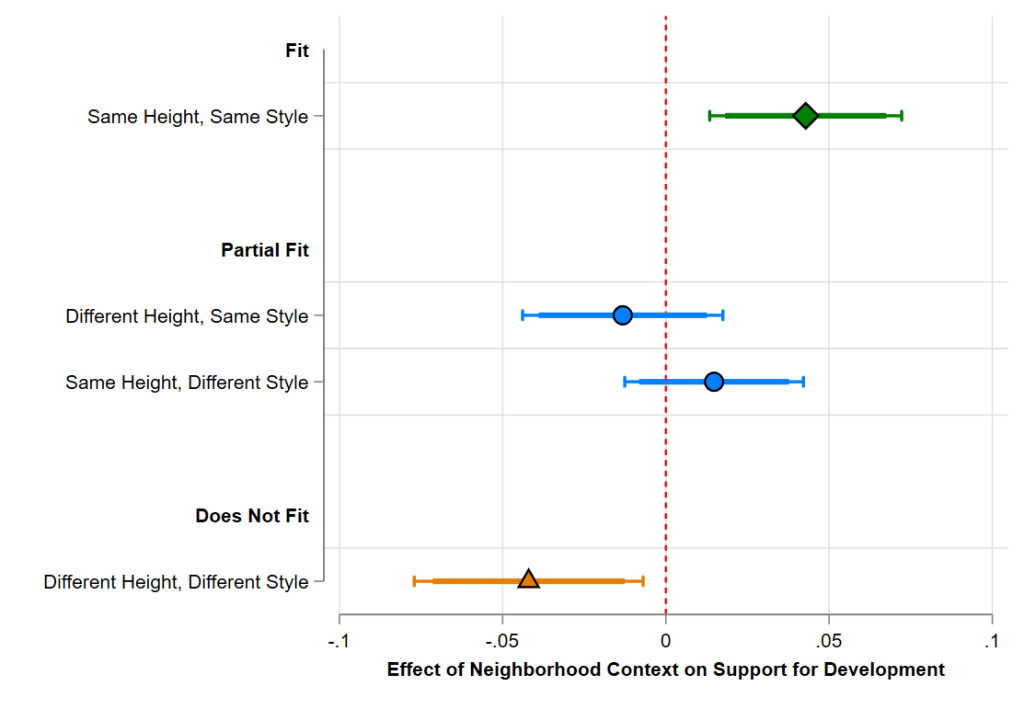
American cities face a housing affordability crisis, partly because of public opposition to dense housing. Explanations have focused on property values, congestion, or demographics. This literature neglects a factor familiar to urban planners: architecture. We argue that people have contextual development preferences and oppose developments that don’t “fit” the surrounding neighborhood in height and style. We test this hypothesis with survey experiments employing a novel visual approach with tightly controlled but realistic images of buildings and neighborhoods. We find that buildings which fit are supported more, an effect which isolates the interaction of building architecture and context. The effect holds for homeowners and renters, and urbanites and suburbanites, suggesting it is not driven by concerns over property values or density alone. Moreover, buildings that don’t fit prompt intentions to engage in costly political behavior. When we impose tradeoffs, support drops, but remains high, suggesting contextual fit preferences are meaningful.
Works in Progress
City of Yes? The Spatial Scale of Housing Reforms, NIMBYism, and Democratic Responsiveness
Spatial policymaking – such as the siting of new housing – is often controversial, activating “not-in-my-backyard” (NIMBY) opposition. Does widening the spatial scale of policies over a larger geography improve support? I test this using a pro-housing reform in New York City, the City of Yes. In a survey experiment of verified voters, fielded before policy adoption, I visually manipulate the spatial scale of otherwise identical reforms and find that widening the scale from the neighborhood to the citywide level improves support. These effects are strongest among homeowners – eliminating two-thirds of the homeowner renter public opinion gap – for reasons unrelated to financial self-interest. Open-ended comments suggest the wider spatial scale alleviates concerns about localized externalities. Finally, elected officials’ votes deviated from their districts’ preferences. Biased democratic responsiveness correlates with the positions of local meeting attendees, suggesting that barriers to reform reside in decisionmakers who either misperceive or discount broader public opinion.
 Adrian Pietrzak